Tricky Story 2: Brain Twist
- 4.6
- Rating
- 1.00M
- Installs
- Free
- Price

 Analysis by App-foxy
I spent time with Tricky Story 2: Brain Twist as a puzzle game rather than treating it as a quick collection of random brain teasers. Its main appeal is the way it asks me to question the obvious answer. A scene may appear simple at first, yet the solution often depends on noticing an unusual detail, interpreting the wording carefully, or trying an action that a conventional logic puzzle would not suggest. That makes it a pleasant fit for short breaks, although it can also become frustrating when a puzzle feels more like a guessing exercise than a reasoning challenge.
The game is developed by XGame HK and is available free of charge, with optional in-app purchases ranging from $0.99 to $79.99 per item. It is listed for Everyone, works on Android 8.0 or later, and the current version is 1.0.11. Its audience is broad, but “Everyone” should not be confused with “effortless for everyone”: the real experience depends on how comfortably a player can read small on-screen details, tap accurately, and tolerate trial and error.
How the puzzles read and how the interface guides you
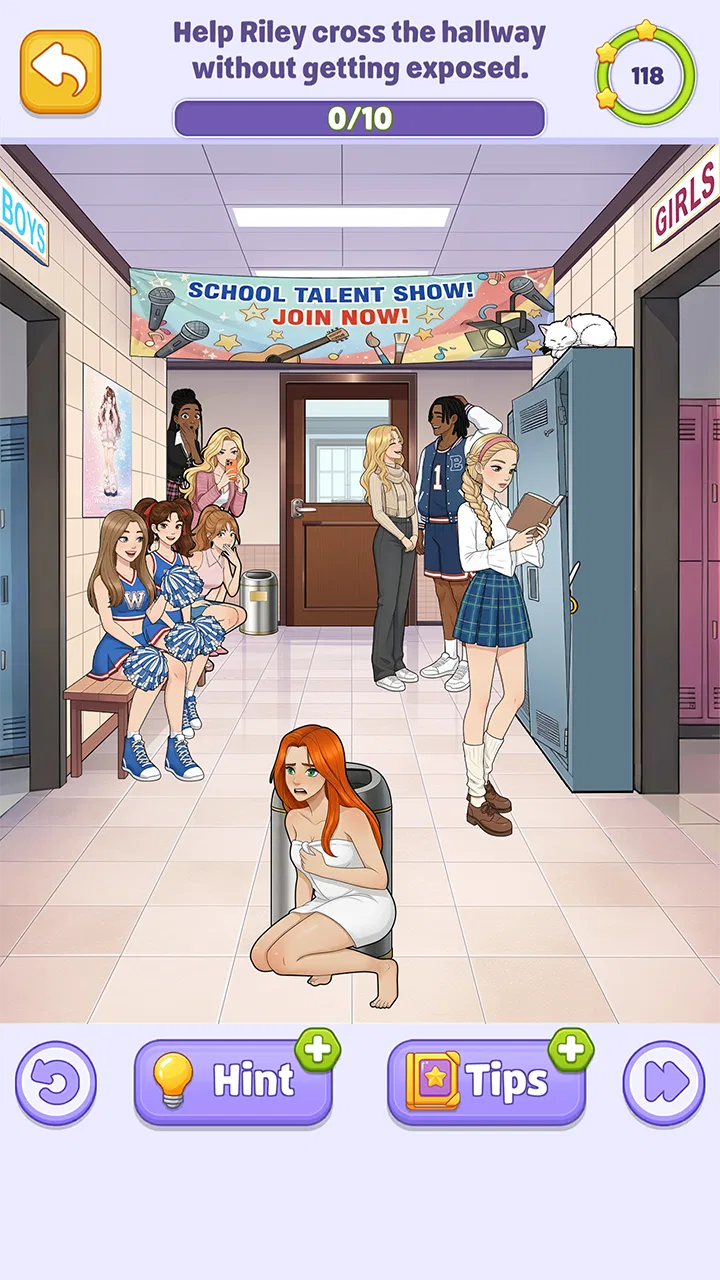
The first thing I noticed is that the game depends heavily on visual reading. The puzzle scene, the objects inside it, and the wording of the prompt work together. I rarely needed a long explanation before starting, which is useful when I only have a few minutes. The challenge is usually not learning a complicated control scheme; it is understanding what the game considers relevant.
You May Also Like

 Blood Strike: 2.5 Anniversary
Blood Strike’s Loadouts Turn Every Drop Into a Tactical Gamble
A close look at Blood Strike’s custom loadouts: how fast access to signature weapons reshapes its battle royale rhythm, rewards preparation, and narrows the gap between fights.

 Pandora - Music & Podcasts
Pandora’s Music Is Easy to Start, but Harder to Recover
Pandora’s strength is its low-effort path from a seed to a station. Its weak spot is how much confidence it asks you to place in connection, setup, and quiet recovery.

 8 Ball Pool
 Is Built on Rivalries, Rematches, and Routine
A close look at the rivalries, rematches, shared routines, and unanswered safety questions that turn a quick pool match into a persistent mobile community.

 Samsung Music
’s Quiet Strength Is Playing What You Already Own
Its reach comes less from spectacle than from dependable access to a personal library. That simplicity is both the app’s strongest retention engine and its ceiling.

 AccuWeather: Weather Radar
AccuWeather Review: A Quick, Clear Forecast for Everyday Decisions
For everyday plans, the best forecast is the one you can understand quickly. AccuWeather makes rain timing, radar, and local conditions easy to act on, with a few trade-offs.

 Hill Climb Racing
Why Hill Climb Racing Still Turns Crashes Into One More Run
A tiny car, a bumpy hill and one more upgrade: Hill Climb Racing keeps resurfacing because its simple chaos makes every near-miss feel personal.
More From Our News Desk



That simplicity helps navigation. Someone who is comfortable with mobile games can generally begin experimenting without studying a manual. The interaction style suits players who prefer direct tapping and observation over menus full of settings. I also found that the short, self-contained nature of the puzzles makes it easy to stop and return later without committing to a long session.
There is a trade-off, though. Clear navigation does not always mean clear reasoning. A puzzle can present a neat-looking scene while hiding the important clue in a small object or an unexpected interpretation of the instruction. When I was stuck, I had to step back and inspect the entire screen instead of focusing only on the most obvious character or item. That is a useful habit, but new players may initially feel that the game is withholding the rules.
For better readability, I recommend holding the phone at a comfortable distance and checking the edges of the scene before tapping repeatedly. I also found it helpful to read the prompt twice: first for its ordinary meaning, then for words that might be deliberately ambiguous. This is one of the more valuable techniques in the game because many failures come from acting too quickly rather than from lacking puzzle ability.
The game’s store summary presents it as a smart quest built around mind logic riddles and puzzle games. In practice, I would describe it more precisely as a visual trick-puzzle experience. It rewards flexible interpretation more than formal deduction. If you enjoy traditional number puzzles, grids, or carefully structured logic problems, some stages may feel loose by comparison. If you like discovering the intended joke or hidden interaction, the format is much more inviting.
The public response is strong, with an average rating of 4.6 from around 29 thousand ratings. That does not guarantee that every puzzle will suit every player, but it does reflect a sizeable audience finding the basic format enjoyable. The game has also passed one million installs, so it is not an obscure experiment with no established player interest.
Readability is more than font size
For me, readability here includes the relationship between text and image. A short instruction may be easy to read but still difficult to interpret if the scene contains several possible targets. Players who process information better when instructions are explicit may need extra time to connect the wording with the visual clue. I would avoid playing while rushing, because the game’s trick structure rewards careful observation more than speed.
People with attention difficulties may appreciate the compact goals, since each puzzle gives a limited task rather than an enormous open-ended objective. At the same time, visual clutter or deliberately misleading details can make it harder to know where to begin. A practical approach is to divide the screen into areas, inspect each one once, and only then start testing interactions. That turns random tapping into a repeatable method.
Players who use a larger display may find scene inspection more comfortable than on a small phone, especially when a clue is tucked into a busy illustration. I would not choose the smallest available screen if visual precision is already tiring for you. The game is still playable as a casual title, but comfort can make the difference between a satisfying “aha” moment and an exhausting search.
Motor demands, sensory load, and the value of slow play
The basic control idea is approachable because it relies on ordinary touch interaction rather than complex movement combinations. That makes it more suitable for players who want a low-input puzzle game. However, simple controls are not automatically easy for every hand. If a solution depends on tapping a particular object, a player with limited precision may need several attempts, especially when the target is visually small or surrounded by other tappable-looking elements.
I found that playing with one hand was convenient during easy stages but less comfortable when I needed to examine the whole scene and reach different areas. Using both hands, or placing the phone on a stable surface, reduced accidental taps. This is a small adjustment, yet it matters for anyone dealing with tremor, fatigue, or reduced range of motion.
The sensory side is equally important. Puzzle scenes can contain many visual elements competing for attention, and the trick often depends on noticing something that looks unimportant. Players who are sensitive to visual busyness may prefer shorter sessions with breaks between stages. I would also lower the device’s general brightness if the screen feels tiring, although that is a phone-level adjustment rather than a feature I would attribute to the game itself.
There is no need to approach every stage as a speed test. In my experience, slowing down improves both accuracy and enjoyment. I use a three-step routine: read the instruction, scan the scene, then test the least obvious possibility. This is especially useful for players who become frustrated by repeated failed taps. It also reveals an important design trade-off: the game’s surprise comes from unconventional solutions, but that same surprise can feel unfair when the clue is too subtle.
For players who prefer audio-led interaction, this is probably not the strongest match. The central information is visual, and the puzzle-solving process depends on seeing relationships between words, characters, and objects. Likewise, anyone looking for a purely tactile or spoken puzzle experience should consider a different category of game. Tricky Story 2 is best approached as a screen-focused observation challenge.
Using it during commutes, breaks, and shared play
The short-puzzle format works well in everyday situations. I can imagine opening it during a waiting-room break, playing a few stages while commuting, or handing the phone to a friend to see whether they notice the clue I missed. It does not require the same uninterrupted concentration as a long adventure game, and that makes it easier to fit around ordinary routines.
There is one situational limitation: visual puzzle games are not ideal when the phone is moving or the environment is distracting. On a crowded bus, I may understand the instruction but miss a small detail because the screen is bouncing or glare is covering part of the scene. I get better results when I play while seated, with the display angled away from direct light.
The game can also work as a light social activity. Instead of passing the phone around and letting everyone tap randomly, I prefer asking another person to describe what they see before either of us interacts. That turns the puzzle into a discussion about assumptions and attention. It is particularly enjoyable with someone who approaches problems differently, because one player may notice the wording while the other focuses on the objects.
For families, the Everyone age rating makes the title broadly approachable, but children and adults may not experience the same difficulty. Younger players may enjoy the visual surprise, while adults may overthink a simple solution. I would treat it as a shared thinking game rather than assume it will teach formal logic. Its strongest educational value is encouraging observation, flexible interpretation, and patience with misleading first impressions.
People who want a game for quiet nighttime use should consider the screen-focused design and the possibility of mental irritation when a solution does not immediately appear. I personally enjoy a few stages before bed, but I stop when I notice myself tapping without thinking. The game is most rewarding when I am curious; it loses much of its charm when I am only trying to clear a stubborn puzzle.
Where the experience can become a barrier
The biggest barrier is the difference between a clever trick and an arbitrary answer. A conventional logic puzzle usually gives me rules that I can apply consistently. Here, the intended solution may depend on recognizing the developer’s particular sense of misdirection. When I solve one stage, I learn the game’s style, but that does not always make the next stage predictable in a satisfying way.
Hints can be tempting in any puzzle game, especially when I have already tested the obvious options. Because optional purchases are part of the experience, I would advise players who dislike spending to decide in advance how they will handle difficult stages. The game is free to start, but the presence of paid items means a completely frictionless experience should not be assumed. I prefer setting a personal rule: try a structured scan first, take a break second, and only then consider whether continuing is worth it.
Another barrier is the possibility of repeated experimentation. A player with limited motor control may find a missed tap more tiring than a player who can quickly test every object. A player with visual processing differences may need more time to separate decorative elements from clues. The game’s basic simplicity helps, but it does not remove these demands. I would recommend trying it in a calm setting and judging comfort after several puzzles rather than deciding from the opening screen alone.
It is also not the best alternative to every puzzle genre. Compared with a crossword, it offers less language depth. Compared with Sudoku, it provides fewer stable rules and less measurable deduction. Compared with a story-driven adventure, it gives less narrative continuity. Its advantage is immediacy: I can inspect a scene, form a hypothesis, and get a quick reaction. Choosing it over those alternatives depends on whether surprise matters more to me than structure.
The release date is January 16, 2026, and the current version is 1.0.11. That places the game in a relatively early stage of its listed release history, so I would keep expectations focused on the puzzle experience itself rather than assume a large, mature ecosystem around it. The developer is XGame HK, and the title’s identity is clear enough: visual brain teasers designed for quick interaction, not a broad platform with many unrelated modes.
Who should try it, and who should skip it
I would recommend it to players who enjoy noticing odd details, challenging the first interpretation of a sentence, and sharing “how did you see that?” moments with friends. It is also a good fit for someone who wants a puzzle game that can be played in small portions without learning elaborate controls. The free entry point makes it easy to sample the style before deciding whether the optional purchases are worthwhile for you.
I would be more cautious recommending it to someone who wants rigorous, rule-based logic, a calm minimalist interface, or a puzzle experience designed primarily around audio. Players who become annoyed by trial and error may also prefer a game that explains its mechanics more directly. The same unpredictability that makes Tricky Story 2 entertaining can make it feel less fair when the intended interaction is not visible from the wording or scene.
My most useful advice is to treat each puzzle as an observation exercise, not a race. Read the instruction aloud if that helps, inspect the entire screen, and ask what assumption the game expects you to challenge. If you are playing with another person, compare what each of you noticed before touching anything. These habits reduce blind tapping and make the game’s unusual solutions feel more earned.
For accessibility in everyday use, I would choose a larger screen when possible, play in steady lighting, take breaks when visual attention drops, and use a stable surface if precise tapping is uncomfortable. Those adjustments cannot change the underlying design, but they can make the experience less demanding. If a puzzle remains inaccessible or exhausting after those changes, switching to a more structured or text-light alternative is the sensible choice.
My inclusive verdict
Tricky Story 2: Brain Twist succeeds when its visual misdirection produces a genuine moment of discovery. I like that it asks me to reconsider ordinary assumptions instead of simply calculating an answer, and the compact format fits naturally into spare minutes. Its broad age rating, free starting price, and straightforward touch interaction make it approachable for many players.
Still, approachability has limits. The game depends on visual detail, careful reading, and experimentation, while some solutions may feel arbitrary to players who prefer transparent rules. Small targets, busy scenes, screen glare, and the pressure to consider optional purchases can all affect comfort. Those are not reasons to dismiss it, but they are important when deciding whether it matches your needs.
Overall, I see it as a friendly casual puzzle game for flexible thinkers rather than a universal brain-training tool. I would recommend giving it a try if you enjoy visual riddles and can play at your own pace. I would skip it in favor of a more predictable puzzle format if accessibility requires strong control over text, visual complexity, or interaction precision. For the right player, its best moments come from learning to pause, look again, and challenge the answer that first seems obvious.
FAQs for Tricky Story 2: Brain Twist
01What is the main gameplay of Tricky Story 2: Brain Twist?
Tricky Story 2: Brain Twist is a puzzle game designed to challenge your brain in creative ways. The game features a variety of levels with unique brain teasers and tricky scenarios. Each level requires out-of-the-box thinking and problem-solving skills to progress, making it both fun and intellectually stimulating.
02Is Tricky Story 2: Brain Twist suitable for all ages?
Yes, Tricky Story 2: Brain Twist is designed for a wide age range. While the puzzles are challenging, they are also family-friendly and free from inappropriate content, making it a great choice for children, teenagers, and adults who enjoy testing their mental agility and creativity.
03Does Tricky Story 2: Brain Twist require an internet connection?
Tricky Story 2: Brain Twist can be played offline, meaning you don’t need a constant internet connection to enjoy the game. However, an internet connection may be required for downloading updates or accessing certain online features, such as leaderboards or social sharing.
04Are there in-app purchases in Tricky Story 2: Brain Twist?
Yes, Tricky Story 2: Brain Twist includes in-app purchases. These purchases can enhance your gaming experience by offering hints or unlocking additional levels. While the game is free to download, some players might choose to make purchases to help them advance more quickly through difficult levels.
05How does Tricky Story 2: Brain Twist handle user data and privacy?
Tricky Story 2: Brain Twist takes user privacy seriously and complies with standard data protection regulations. The app may collect data to improve user experience and game performance, but it does so in accordance with its privacy policy. Users are encouraged to review the privacy policy to understand what data is collected and how it is used.
Pros
- Engaging puzzles keep players challenged.
- Visually appealing with vibrant graphics.
- Intuitive controls make gameplay smooth.
- Regular updates add new content.
- Encourages creative problem-solving.
Cons
- Some puzzles may seem repetitive.
- In-app purchases can be pricey.
- Occasional ads disrupt gameplay.
- Limited hints can frustrate some users.
- Requires internet for full features.

Tricky Story 2: Brain Twist
Gallery